
AI Makerspace
The AI Makerspace is a dedicated environment for experimentation, creation, and applied innovation. It is a place where ideas move beyond theory and take physical form, where artificial intelligence becomes something you can see, test, and refine.
The Makerspace provides access to advanced technologies such as robotics platforms, 3D printers, electronics workstations, and computational resources. These tools are supported by structured workflows and expert guidance, enabling rapid experimentation and iteration while maintaining safety, quality, and efficiency.
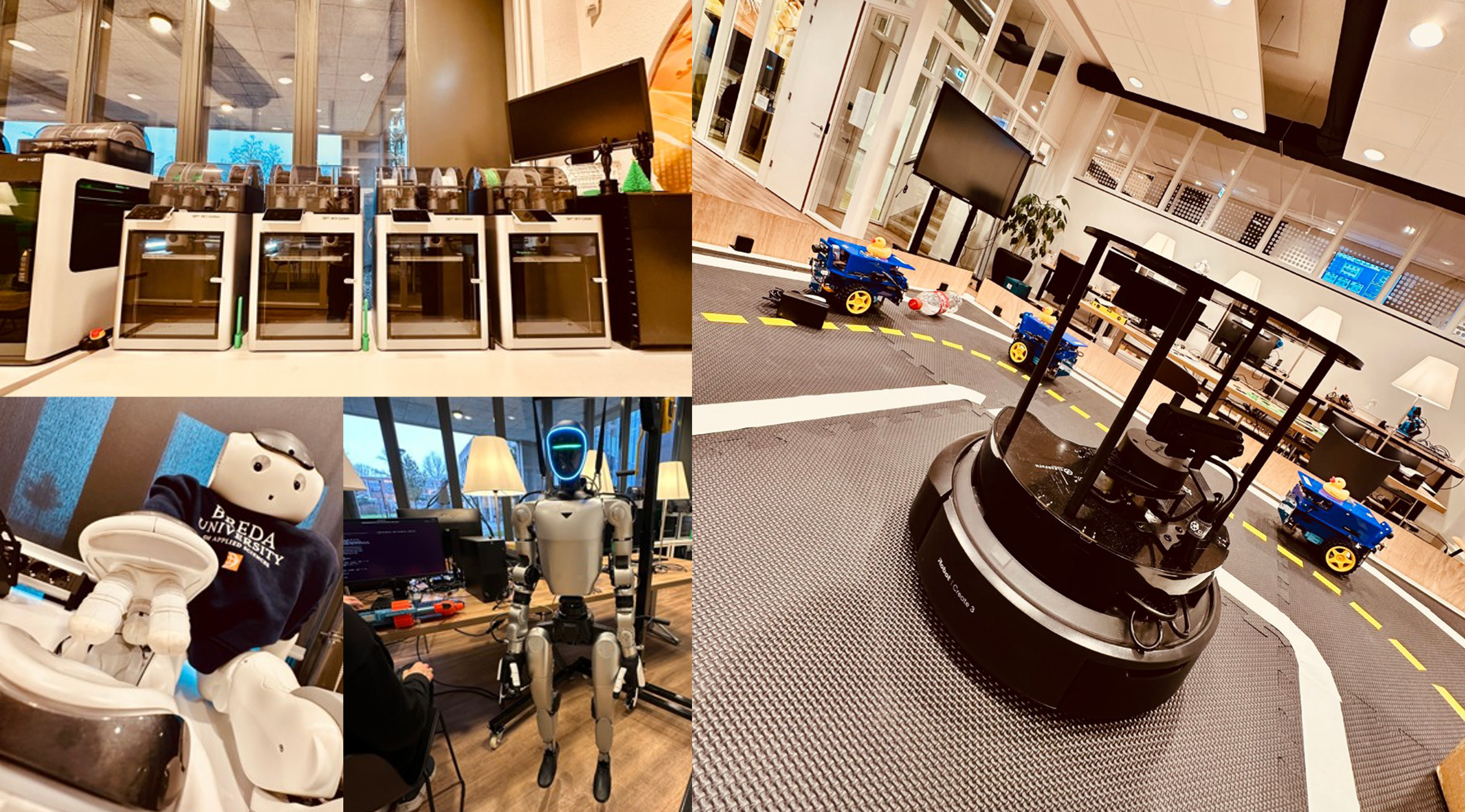
The AI Makerspace is built on the belief that meaningful learning happens through doing. Prototyping, testing, failing, and improving are central to innovation. By working hands-on with machines, code, and materials, users develop not only technical skills but also creative problem-solving ability, collaboration, and confidence.
Within this space, ideas are transformed into tangible outcomes. From early concepts to functional prototypes, users can design, print, assemble, and automate. Whether building intelligent systems, experimenting with robotics, or exploring new interactions between software and hardware, this is a place where imagination meets execution.
What Our Students Are Building
Our students have access to the AI Makerspace throughout their studies. They use this environment for both short, focused projects such as end-of-block challenges, as well as larger projects including graduation theses and specialization projects that span approximately five months.
Our second year students, Maciej, Andrii, Koen, and Raya worked with Duckietown, an educational robotics platform designed to teach autonomous driving, computer vision, and robotics in a controlled, miniature environment. The platform consists of small robotic vehicles equipped with cameras and onboard computation, navigating a scaled-down city with roads, lanes, and intersections.
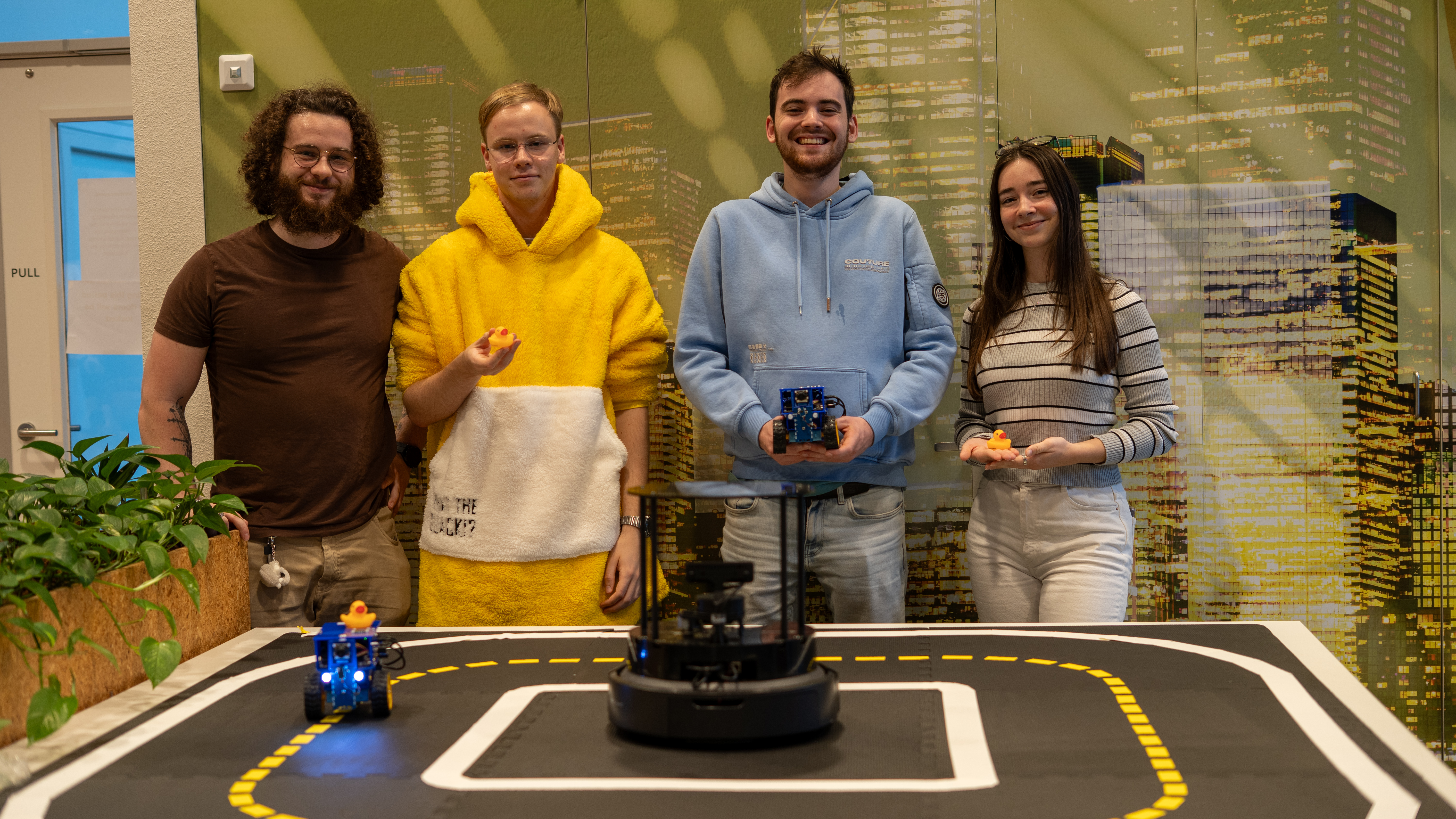
Within this project, they designed and implemented algorithms that enabled the robots to perceive their environment and act accordingly. This included lane following, obstacle detection, and decision-making at intersections. By working with a physical system, they experienced the challenges of deploying AI in real-world conditions, including noise, uncertainty, and system constraints.
The project connected software and hardware in a meaningful way. They moved from developing models in notebooks to deploying them on embedded systems, testing them in real environments, and iterating based on observed behavior. This process reflected how modern AI systems are developed in practice.
Through projects like these, the Makerspace enabled students to develop a deep, applied understanding of AI, preparing them to design, build, and deploy intelligent systems beyond the classroom.