
Places and Flows Lab
Overview
The Places and Flows Lab explores how people experience and interact with physical environments by combining geospatial data, human behaviour, and interactive technologies.
Cities, landscapes, and destinations are constantly in motion. People, goods, and information flow through them every day. To design meaningful, sustainable, and resilient places, it is essential to understand both these flows and how people perceive them.
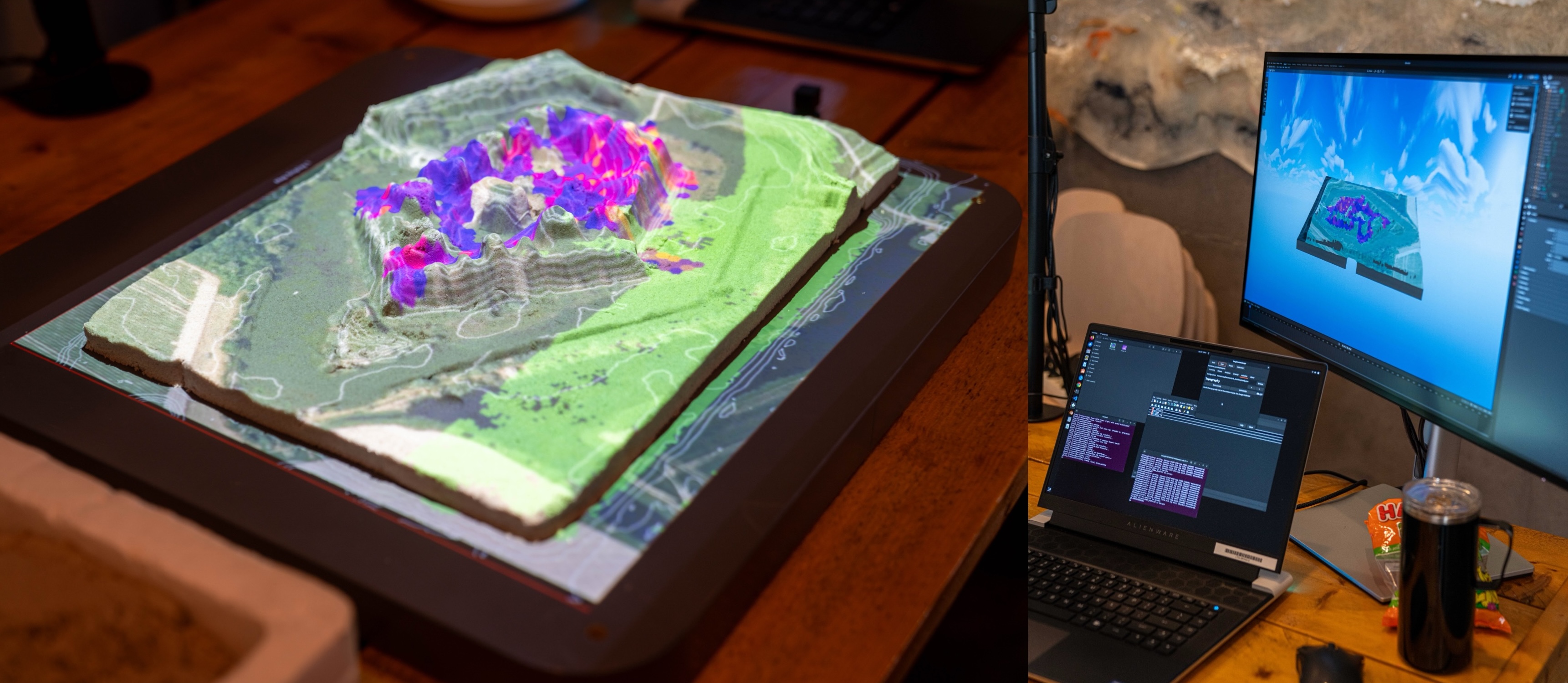
At the core of the lab is the Tangible Landscape, an interactive system that connects physical landscape models with digital geospatial analysis. Users can shape terrain by hand and instantly see the effects of their actions through projections powered by tools such as GRASS GIS, QGIS, and Blender. This enables real-time analysis of visibility, mobility, land use, and environmental dynamics.
The lab also extends beyond spatial modelling into human-centered analysis. By combining geospatial data with physiological signals such as skin conductance, researchers can study how environments influence emotional responses. This allows the lab to generate insights into how design decisions impact experience, for example identifying where people feel stress, excitement, or calm in real-world environments.
Projects in the lab span domains such as urban planning, tourism, mobility, and climate adaptation. The focus is always on making complex spatial problems tangible, interactive, and understandable for both researchers and stakeholders.
What Our Students Are Building
Interactive Geospatial Systems & Tangible Landscape
Maciej Czerniak and Szymon Chirowski, second-year ADS&AI students, work as a student assistant developers in the Places and Flows Lab. Their work focuses on building and maintaining interactive geospatial systems based on Tangible Landscape.
A key part of their role is ensuring that the full pipeline works reliably in real time. This includes integrating depth sensors such as the transition from Xbox Kinect to the Orbbec Femto Bolt, adapting the system to new hardware, and improving low-level components such as the r.in.kinect GRASS GIS module in C++.
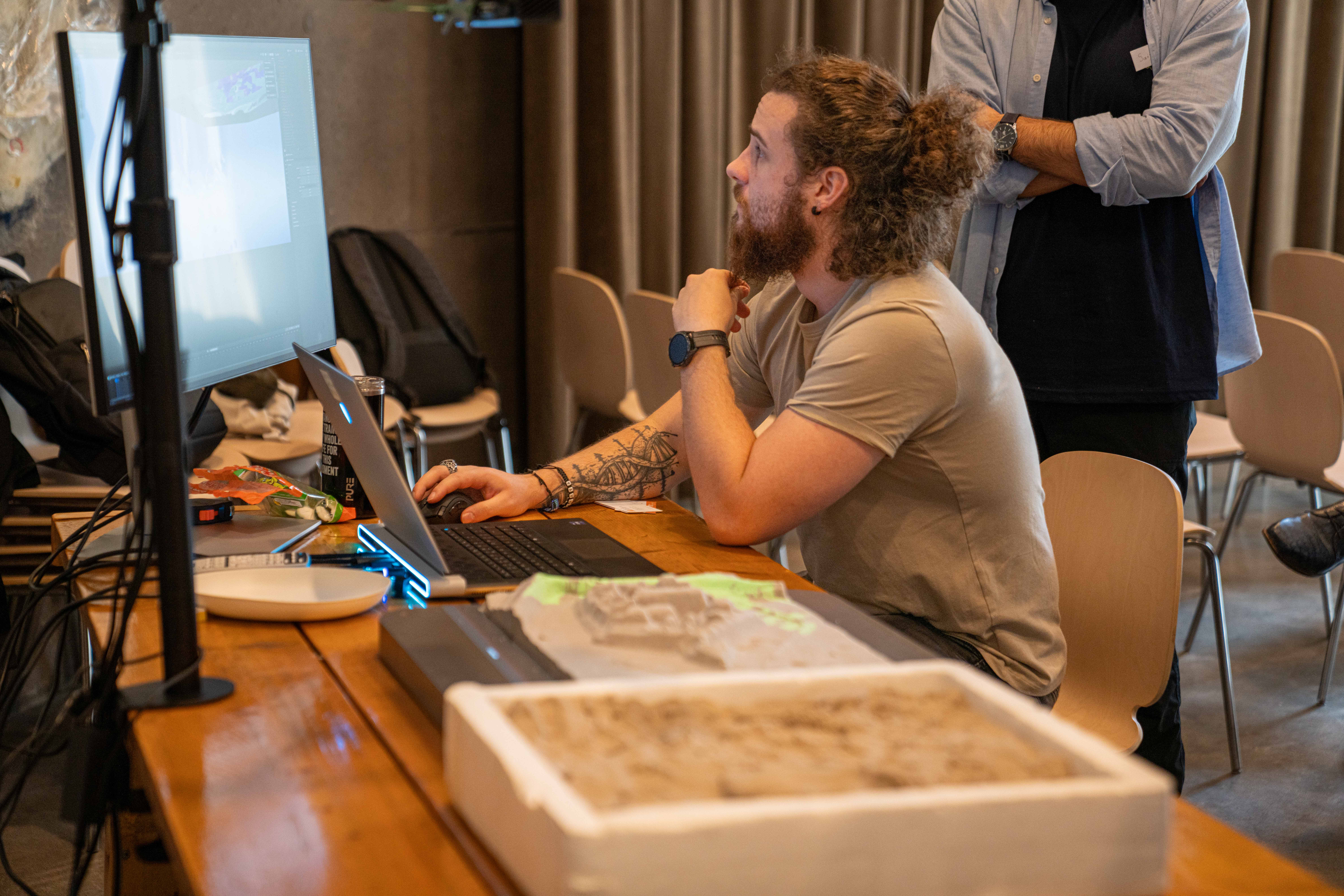
Within this system, Maciej and Szymon develops new interactive features, such as a tree planting activity where users can physically modify a landscape model and immediately see spatial analysis results. They also work on stabilizing existing activities such as viewshed analysis and topography simulations, while ensuring seamless integration between sensors, GIS tools, and visualization layers.
The broader project connects spatial data with human experience. By combining terrain data, viewshed analysis, and physiological signals such as skin conductance, the system allows researchers to study how environmental features influence emotions. This creates a pipeline from physical interaction to spatial analysis and human-centered insight.
Through this work, Maciej and Szymon develop skills in Python, C++, GRASS GIS, and real-time system integration. They also gains experience working with complex, multi-component systems where hardware, software, and data pipelines must operate together reliably. Their experience highlights an important aspect of applied AI: real-world systems require not only models, but robust engineering and integration across technologies.
Modelling Urban Traffic Flows
Lars Peggeman, a second-year Data Science and Artificial Intelligence student, contributes to the lab as a student assistant researcher, focusing on modelling and simulation of urban traffic systems.
His work is part of the LILS project, which investigates last-mile traffic flow in Breda, specifically on Wilhelminastraat and Nieuwe Ginnekenstraat. The goal is to understand how delivery-related disruptions affect traffic throughput and to support data-driven decisions about urban infrastructure.
Lars works with field-collected data and transforms it into statistical models and simulations. He has analysed inter-arrival times of vehicles, fitted probabilistic distributions such as hyper-exponential and gamma models, and quantified the impact of real-world blockage events on traffic flow.
To make these insights accessible, he developed a PyQt6 application that visualises traffic flows, observation points, and disruption events in an interactive interface. These results are also integrated into the Tangible Landscape system, allowing users to physically interact with a 3D model of the street and immediately see how changes affect traffic behaviour.
The next step of the project is the development of an agent-based simulation using frameworks such as SimPy, with potential integration into GIS-based simulation environments. This would enable more advanced scenario testing and decision support.
Through this work, Lars applies statistical modelling, data processing, and simulation design from the AI program in a real-world context. His experience demonstrates how data science can directly contribute to solving complex urban challenges by combining data, modelling, and interactive systems.